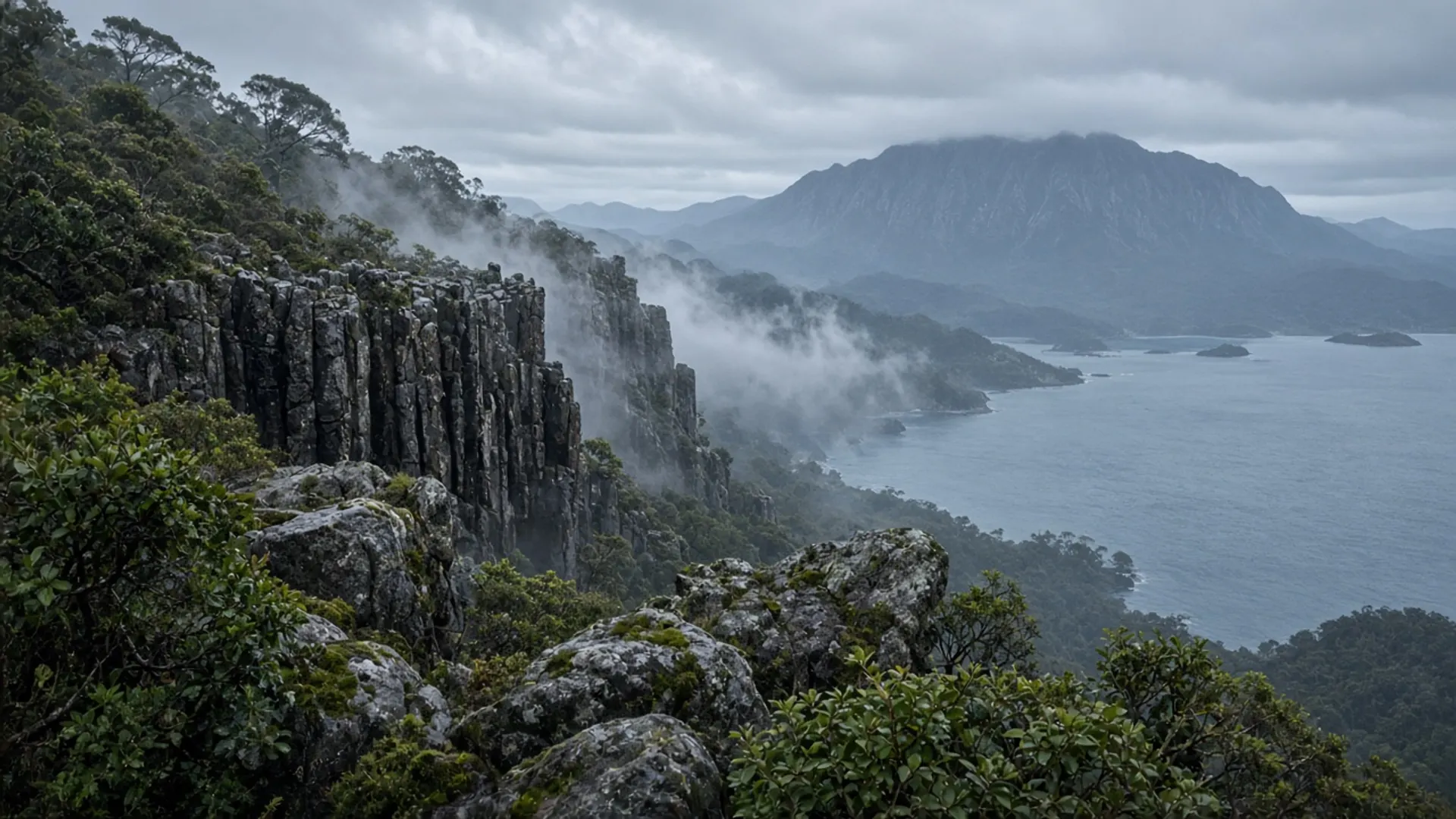
Three days in southern Tasmania is a harbour-and-peninsula trip, not an island circumnavigation. Sleep in or near Hobart, give one day to the mountain and the city, one day to Bruny Island or the Tasman Peninsula, and one day to the Huon or a slower harbour walk. Leave Cradle Mountain, Freycinet and the west for a different week.
Southern Tasmania is where most visitors first stand still. The Derwent is a working river. kunanyi / Mount Wellington is a dolerite wall that can hold snow while the waterfront is only jacket-cool. South of the city, the Huon Valley and D’Entrecasteaux Channel turn into orchard, timber and ferry country. Further south-east, the Tasman Peninsula holds some of the tallest sea cliffs in the Southern Hemisphere and the Port Arthur Historic Site. You can taste that south in three days. You cannot collect it all.
What “the south” means on this page
On the old site, a “3-day tour southern Tasmania” sat next to an east-coast loop and a west-and-Wineglass sketch. That IA was right. The south is a cluster:
- Hobart and nipaluna — sandstone warehouses, Battery Point lanes, a waterfront that is still a working port.
- kunanyi / Mount Wellington — a road to a summit plateau when weather allows; alpine vegetation a short drive from the CBD.
- Huon Trail country — Huonville, Geeveston, the road toward Hartz Mountains National Park, and the timber towns that once floated huon pine.
- Bruny Island / lunawanna-alonnah — two islands joined by a narrow neck, reached by ferry from Kettering.
- Tasman Peninsula — Port Arthur, the Three Capes walking country, and sea cliffs that belong to a different day-trip logic.
Three days holds two of those clusters well, or one cluster deeply. It does not hold five.
A three-day pattern
Day 1 — City, mountain, weather veto
Arrive and walk the waterfront while your legs still remember an aeroplane. Battery Point is the compact historic suburb on the point; it is a lived-in place, not a set. The mountain road is the afternoon question. If the summit is in cloud, the foothill springs and lookouts still tell you the dolerite story. If the summit is clear, take layers: the plateau is an alpine environment even when Hobart is mild.
Do not treat Salamanca as the whole city. The Domain, the Cenotaph ridge, and the older cottages above the docks give you the scale of a town that became a capital because of a deep harbour, not because of a beach.
Day 2 — Bruny or the Tasman, not both
This is the fork.
Bruny Island is a ferry day. You will lose time in a queue at Kettering in peak season; that is part of the island’s physics. Once across, the Neck lookout, Adventure Bay, the southern national park walks, and the slower townships of Alonnah and Adventure Bay are a full day without adding a “gourmet trail” checklist. We keep the historic misspelled path bruny-islad-sightseeing-gourmet-tour as a rewritten guide, not as a product. South Bruny National Park needs a parks pass. Cape Bruny Lightstation sits at the end of a road that feels longer than the map.
The Tasman Peninsula is a road day. Port Arthur Historic Site is a ticketed, interpreted convict precinct — confirm hours and tickets with the site itself; we do not reprint them. The Three Capes Track is a multi-day, booked walk and is not a three-day add-on. Lookouts and shorter cliff walks can fill a day if you leave Hobart early and accept that you will not also do Bruny.
Choose one. People who try both remember the dashboard.
Day 3 — Huon, channel, or a second city walk
A southern third day should be slower. The Huon Valley road toward Geeveston and Hartz is a change of air: apple country, river flats, wet sclerophyll. Hartz Mountains National Park is a high, moody park and a parks-pass place; check snow and wind before you promise a tarn walk in spring. Alternatively, stay in the channel villages, or walk Hobart as if you live there — Queen’s Domain, a museum, the mountain foothills — and leave for the airport without a third peninsula.
Bridgewater is the northern river crossing, not a destination, but it is how many self-drivers join the Midland Highway when they eventually leave the south. Bushy Park sits up the Derwent in hop-growing country if you are heading inland instead of east.
Guided day or self-drive
Hobart is the easiest place on the island to take a guided day. Bruny and Tasman Peninsula days are sold by many operators; we name none of them and invent no prices. A self-drive Bruny day is simple if you accept the ferry as the schedule. A self-drive Tasman day is simple if you accept that Port Arthur is a long site. Read tours for the style argument and Bruny Island tours for the island-specific version.
Winter Bruny is a different texture — lower light, more weather, fewer queues — and has its own heritage path at bruny-island-tour-winter.
What not to bolt on
- Cradle Mountain is a five-hour-class drive from Hobart in good conditions, then a park with its own shuttle and weather. It is not a southern afternoon.
- Wineglass Bay is an east-coast day. Put it on the east-coast itinerary.
- West-coast rainforest is weather and distance. Put it on the four-day west and Wineglass page or give it a week.
Practical notes
- Ferry: Bruny is reached from Kettering. Timetables and queue advice belong to the current ferry operator and the state road pages, not to a frozen sentence here.
- Parks pass: required for South Bruny, Hartz, Tasman National Park walking areas.
- kunanyi weather: the summit road closes. Check the current Hobart council / mountain-road advice.
- 4WD: not required for this itinerary.
- Accommodation: Hobart holds the widest bed stock. Bruny and the Huon are smaller and should be arranged before a peak-summer weekend. We do not list rooms. The heritage Bruny Island accommodation directory is a planning essay, not a live inventory.
Why three days still feels like a trip
Southern Tasmania is dense. You can stand on a waterfront that once chained ships into a convict colony, drive into alpine herbfield, and eat in orchard country without changing motels. Density is not the same as completeness. The old three-day southern page was popular because it admitted a regional scale. This rebuild keeps that admission and writes the geography in public facts: Parks Tasmania for the national parks, the Port Arthur Historic Site for its own precinct, and the ferry as a living constraint.
If you have a fourth day, repeat Bruny more slowly or add the Tasman — still without leaving the south. If you have a week, join this page to the east-coast itinerary and ignore anyone who tells you the west is “on the way”.
Hobart as a base, not a checkbox
Hobart works as a three-night base because the south is radial. You can change the second day’s character when a summit road closes or a ferry queue looks ugly, and you still sleep in the same bed. That flexibility is the hidden luxury of the south. East-coast towns do not offer it in the same way: once you are committed to Coles Bay, Freycinet is the day.
Use the city mornings for things that do not travel well: a museum with actual objects, a Domain walk, a grocery shop that will save you on Bruny. Use the city evenings for being done with a car. The mountain and the peninsula are daylight tools.
Battery Point is worth a slow hour if you treat it as a neighbourhood. It is a poor hour if you treat it as a convict theme park. The cottages are lived in. The lanes are public. The harbour below is why the suburb exists.
Port Arthur without swallowing the peninsula
If you chose the Tasman fork, Port Arthur Historic Site is a long, interpreted precinct in the Australian convict World Heritage serial listing. Give it the hours the site itself suggests — we will not invent a dwell time. The surrounding Tasman National Park cliffs are a different ticket and a different weather. People who “do Port Arthur and the blowhole and a cape lookout and dinner in Hobart” remember the car.
The Three Capes Track is a booked, multi-day walk that starts with a site check-in and a vessel to Denmans Cove. It is not a Saturday add-on to this itinerary. If that walk is the holiday, this three-day page is the wrong document.
Huon and Hartz as weather insurance
The Huon Valley is the south’s inland lung: river flats, apples, timber towns, a road that can still feel like a working landscape. Hartz Mountains National Park sits above Geeveston as a high, often cloudy park of tarns and cushion plants. It is a parks-pass place and a wind place. In spring it can still hold snow. In summer it can still hold a front that Hobart waterfront diners never notice.
If Bruny is cancelled by a personal energy deficit — not necessarily by a ferry cancellation — Hartz or a Huon day is the honest substitute. It is still the south. It is not a consolation prize.
A note on produce language
Southern Tasmania has a justified produce reputation. That is climate and soil, which belong on about Tasmania. It is not a permission slip to reprint a 2012 farm-gate list. Doors close. Seasons move. A “gourmet loop” that cannot name a current opening hour is a rumour. The misspelled heritage gourmet-tour slug exists so old links resolve; it is not a menu.
Sources to confirm the morning you leave
- Parks Tasmania for South Bruny, Hartz and Tasman walking areas.
- The current Kettering–Bruny ferry operator for sailings and queue advice.
- Hobart City Council / mountain-road channels for kunanyi closures.
- Port Arthur Historic Site for precinct hours and tickets.
This page will not freeze those facts. It will keep telling you that three southern days are a regional trip — and that Cradle, Wineglass and the west are other regions.