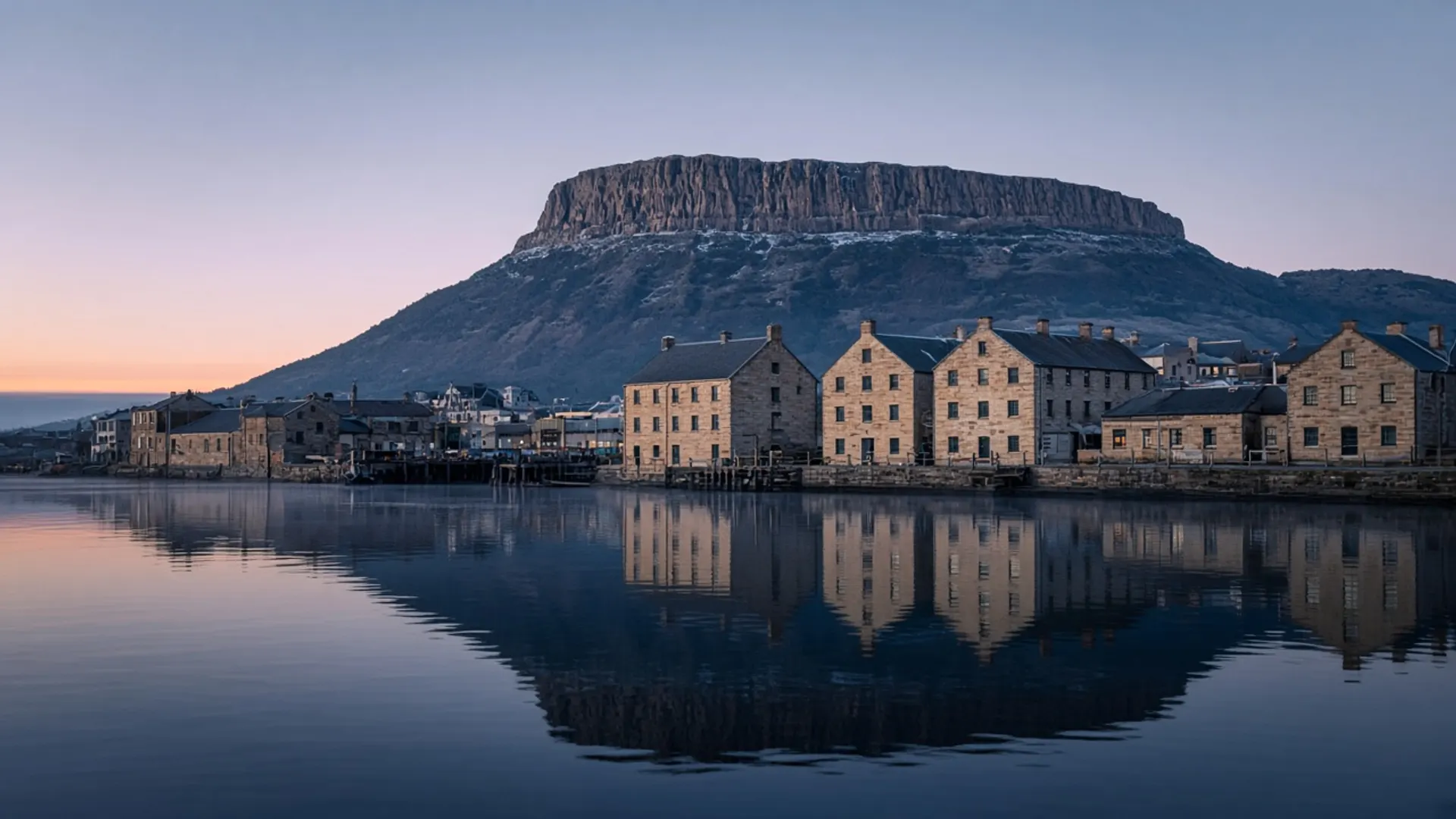
Tasmania is Australia’s island state, separated from the mainland by Bass Strait and from Antarctica by a lot of Southern Ocean. On a wall map it looks like a pendant. On a wet highland road it looks like a country.
This page is the “about Tassie” essay the old site kept as about_tas.htm and later /about-tasmania/. It is not a government welcome. It is the public geography you need before an itinerary starts lying to you.
Country and names
Tasmania is Palawa Country. Aboriginal people have lived here for at least 35,000 years — through a glacial cycle that made this the southern edge of human settlement on the planet. The Tasmanian Wilderness World Heritage Area is inscribed for cultural as well as natural criteria. Dual names such as kunanyi / Mount Wellington and takayna / Tarkine appear in official use. We follow that official language; we do not decorate a paragraph with a word we then ignore.
Lutruwita is a Palawa name for the island that you will see in contemporary public life. Hobart sits on nipaluna. You will travel through living culture whether a lookout sign says so or not.
An island of reserved land
About 40 per cent of Tasmania is reserved. There are nineteen national parks. The World Heritage property alone is about 1.58 million hectares, around a quarter of the state, inscribed in 1982 and later extended. That is not a marketing percentage. It is why a west-coast day feels different from a midlands day.
Parks include alpine Cradle Mountain–Lake St Clair, granite Freycinet, the Tasman cliffs, South Bruny, Hartz, Walls of Jerusalem, Maria Island, Narawntapu, Ben Lomond and others. A parks pass is the visitor’s administrative relationship with those places.
Outside the parks sit conservation areas (the Bay of Fires is a famous one), regional reserves, and a working landscape of farm, forestry, hydro and mining. Butlers Gorge and the Derwent hydro spine are part of the island’s modern story. Beaconsfield is part of the mineral story. Neither is wilderness, and both are Tasmania.
Settled fringe, empty middle
Most people live in the north–south settled crescent: Greater Hobart on the Derwent; Launceston on the Tamar; the north-west cities of Devonport and Burnie; smaller towns along those roads. The Central Plateau, the south-west and much of the west are spare of towns on purpose.
That pattern is why itineraries work as coasts and valleys rather than as a grid. You hop from harbour to peninsula to highway town. You do not “fill in” the south-west on a Tuesday.
Four seasons, a maritime mood
Tasmania has four distinct seasons. Summers are milder than mainland capitals. Winters are colder, especially inland and aloft. The west is wetter; the east is drier and often brighter. The Roaring Forties are not a slogan when you stand on a west-coast beach. Read when to visit for the planning version.
Produce culture — cool-climate wine, apples, cherries, cheese, seafood — sits on that climate. We will not crown a cellar door. We will say the volcanic and dolerite soils plus maritime coolness are the public reason the produce exists. Breweries and accommodation have their own hubs.
Convict and Georgian layers
After New South Wales, Van Diemen’s Land was the next major site of British colonisation. The World Heritage serial listing for Australian convict sites includes Port Arthur, the Coal Mines, Cascades Female Factory, Brickendon and Woolmers, and Darlington on Maria Island. Intact Georgian towns on the Heritage Highway — Campbell Town among them — are part of that settled grain. Battery Point’s lanes are the urban version.
These places are interpreted by their official site managers. This guide will not invent a hanging story for atmosphere.
How visitors usually arrive
- Air into Hobart or Launceston, sometimes Devonport or Burnie.
- Sea on the Spirit of Tasmania into Devonport with a vehicle.
Neither arrival makes the island small. A Devonport arrival points you at the north and at Cradle. A Hobart arrival points you at the south and the east. Choose the itinerary that matches the airport when you can.
Using this rebuild
Heritage “about” files (about_tas.htm, about-tas.html, about-tasmania.html) 301 here. Place pages from Adventure Bay to Cape Portland keep clean slugs with rewritten notes. Spam slugs do not.
If you want a loop, go to itineraries. If you want a vehicle answer, 4WD. If you want the editorial desk, about this guide. Tasmania is the subject. We are not the parks service.