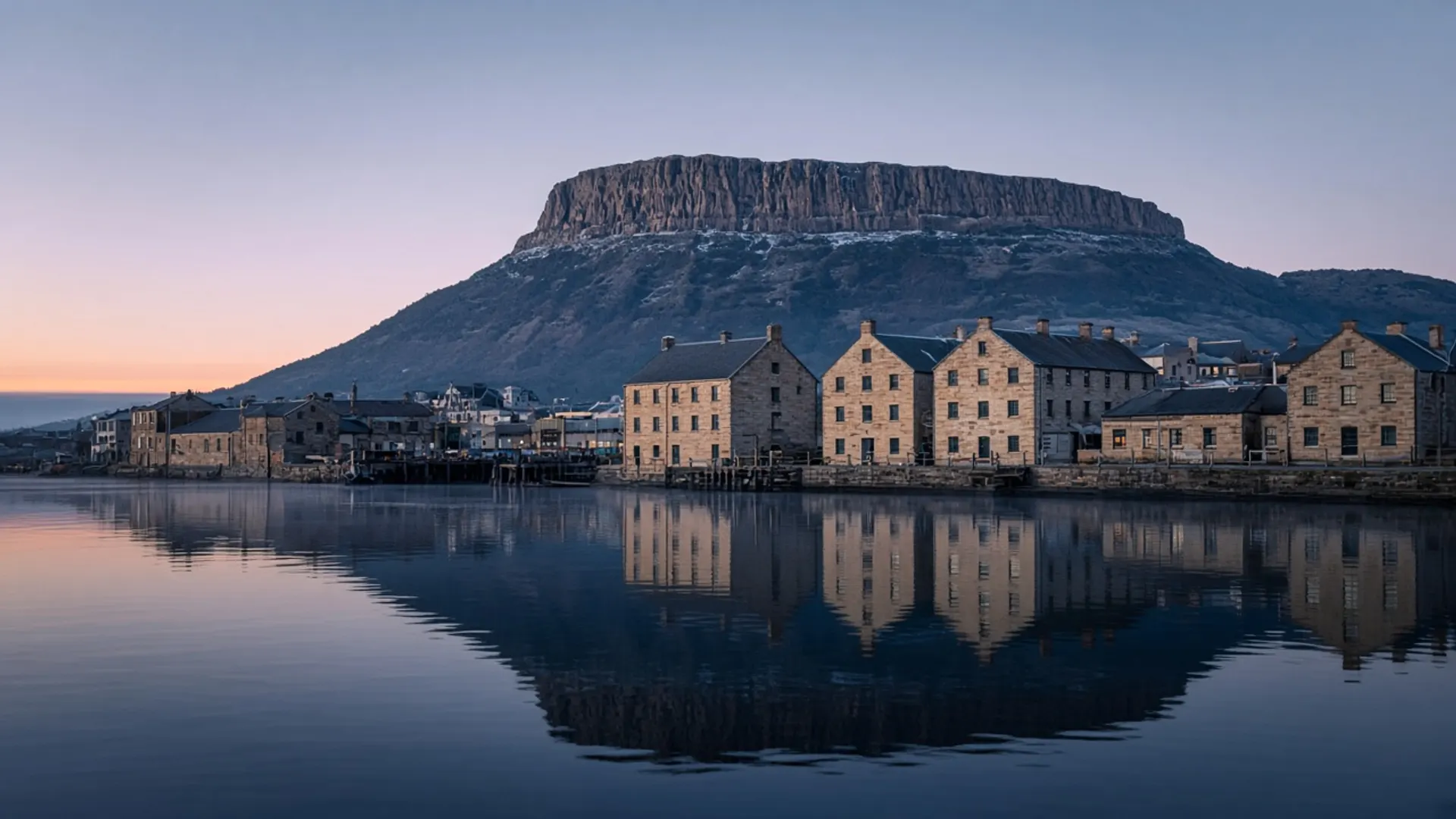
Walk Battery Point as a neighbourhood people still live in, not as an open-air museum with a gift-shop ending. It is the compact historic suburb on the point between Hobart’s waterfront and the Derwent, a short rise from Salamanca Place. Sandstone, brick, and tight Georgian and Victorian lanes are the fabric. Front gardens, parked cars and “please don’t picnic on the wall” are the fabric too.
If you treat it as a theme park, you will be the problem in someone else’s street. If you treat it as a place, it is one of the best hours in the southern itinerary.
A point, a battery, a suburb
The name comes from colonial artillery — the Mulgrave Battery and related harbour defences — not from a brand. Hobart exists because the Derwent is a deep, defensible working harbour. Battery Point is the residential crease of that harbour story: mariners’ cottages, merchants’ houses, and later infill on a hill that still looks at water and kunanyi / Mount Wellington.
Arthur Circus, the round of cottages around a small green, is the postcard fragment. St George’s Church sits on the ridge. Kelly’s Steps drop to Salamanca. Those are public, photographable facts. They are also surrounded by homes. Keep to the street. Do not try doors. Do not fly a drone over backyards because the light was good.
nipaluna / Hobart sits on Palawa Country. The sandstone layer is two centuries old. The Country is not.
There is no parks pass for Battery Point. It is city, not South Bruny National Park. When you later drive to a national park, the Parks Tasmania pass is a different instrument. Do not confuse a heritage walk with reserved land.
Lived-in, not costumed
The old site’s Hobart pages sometimes slid toward “village” language. Battery Point is not a village. It is an inner suburb of a small capital, with real prices of housing (which we will not quote) and real residents. Casinos, cruise-ship days and Salamanca Market mornings change the texture of the streets below. They do not turn the cottages into sets.
What to do instead of a script:
- Walk up from the waterfront after the warehouses, not instead of them.
- Use the lanes as a loop, then leave.
- Combine with the Domain, the Cenotaph ridge, or a museum if you want civic Hobart rather than only cottages.
- If kunanyi is clear, that is a separate alpine road with alpine weather; it is not an extension of Arthur Circus.
We name no cafes and invent no “best pie”. Opening hours on the waterfront move with season and cruise calendars. Confirm what you need the morning you walk. When to visit describes island seasons; Battery Point’s micro-season is “market Saturday versus ordinary Tuesday”.
How it sits in a Hobart day
A first southern day should not be a peninsula. It should be harbour, hill and weather veto. Battery Point is the harbour chapter. Bridgewater is merely how you later cross the Derwent toward the Midlands; it is not a destination and it is not this suburb.
Guided walking hours exist in Hobart. We do not rank them — tours. Self-guided is enough if you can read a street sign and accept that some of the prettiest walls are private.
Do not bolt Battery Point onto a Bruny ferry queue and a Fluted Cape walk as if Hobart were a car park. The three-day southern pattern keeps city and island on different days for a reason. Alonnah and Adventure Bay are Bruny. This is nipaluna.
Convict interpretation in Hobart belongs at official sites — the Cascades Female Factory and related World Heritage places — where site managers set the story. Battery Point’s cottages are not a hanging exhibit. Do not invent one for atmosphere. Read about Tasmania for the public convict and Georgian layer, then let this suburb be houses on a point.
Winter is quieter on the lanes and colder on the harbour. Summer is busier down at Salamanca. Neither season requires a 4WD. You need comfortable shoes and the manners you would use in any tightly built inner suburb. Then go back to the water and remember that Hobart is still a port.